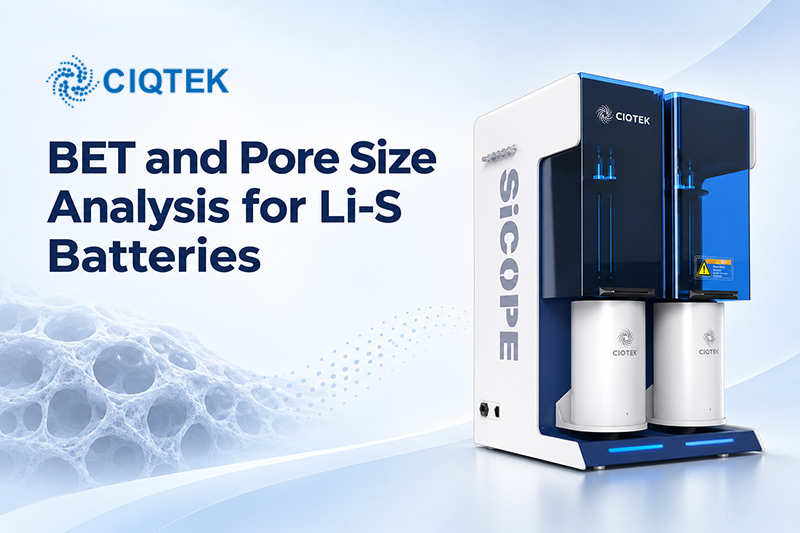
BET and Pore Size Analysis of W,N-Co-Doped Porous Carbon for Li-S Batteries
How can researchers introduce more active sites into porous carbon while preserving the pore structure needed for sulfur loading and ion transport? A recent study explored this challenge by developing tungsten and nitrogen co-doped nanoporous carbon (W,N-C) as a multifunctional sulfur host for lithium-sulfur (Li-S) batteries. Using a CIQTEK specific surface area and pore size analyzer, the researchers quantified changes in pore structure during W,N doping and evaluated the material again after sulfur loading. The results showed that increasing tungsten content gradually reduced specific surface area and pore volume. Among the tested compositions, W,N-C-5 provided a better balance between introducing active sites and preserving the porous structure. After sulfur loading, its BET specific surface area decreased to 5.32 m2/g, while pore volume decreased to 0.009 cm3/g, supporting the conclusion that sulfur had entered and occupied the pore network. The research was conducted by the team led by Xingxing Gu at Chongqing Technology and Business University, in collaboration with the team led by Ya-Xiong Wang at Fuzhou University. The paper, "Multi-functional W,N-co-doped nanoporous carbon contributes to high-performance Li-S batteries," was published in Nano Materials Science. Research paper: https://doi.org/10.1016/j.nanoms.2025.06.003 Why Pore Structure Matters in Lithium-Sulfur Batteries Lithium-sulfur batteries have a theoretical energy density of up to 2,567 Wh/kg, making them attractive for next-generation energy storage. However, several challenges still limit their practical performance. Sulfur and its discharge products, Li2S2 and Li2S, have poor electrical conductivity. Soluble lithium polysulfides can migrate through the electrolyte and separator, causing the shuttle effect. Uneven lithium deposition can also lead to dendrite growth and reduced battery safety. Porous carbon is commonly used as a sulfur host because it provides a conductive framework and space for sulfur loading. However, conventional carbon is nonpolar and interacts relatively weakly with lithium polysulfides. Introducing heteroatoms such as nitrogen and transition metals can improve chemical adsorption and catalytic conversion. The challenge is finding the right balance: more active sites do not necessarily mean better performance if the pore structure is significantly reduced. This is where BET surface area and pore size analysis become important. Material Design: W,N-Co-Doped Nanoporous Carbon The researchers used ramie textile industrial degumming waste liquid as the carbon and nitrogen source, and sodium tungstate as the tungsten source. The materials were freeze-dried and then carbonized at 800°C to prepare W,N-co-doped nanoporous carbon. By adjusting the sodium tungstate concentration to 1, 5, and 10 mmol/L, the researchers prepared three compositions: W,N-C-1, W,N-C-5, and W,N-C-10. A nitrogen-doped carbon sample without tungsten, N-C, was used as the reference. T...
November 23, 2026