Variable-Temperature EPR: Why Temperature Is Your Secret Weapon
May 20, 2026
Temperature is not just an environmental setting in electron paramagnetic resonance (EPR) spectroscopy. It is a core experimental parameter, right up there with microwave power and magnetic field range. Choose the right temperature, and you unlock sharper signals, stronger sensitivity, and structural details that room-temperature measurements simply cannot reveal. Choose wrong, and your signal may disappear entirely. This guide walks through the physics of variable-temperature EPR and helps you pick the right setup for your samples.
Why Temperature Matters So Much in EPR
Every EPR experiment involves three questions. How does temperature reshape the microscopic spin environment? How does it affect spectral interpretation? And which systems absolutely require variable-temperature measurements? Let us break it down.
Cooling: The Simplest Way to Boost Sensitivity
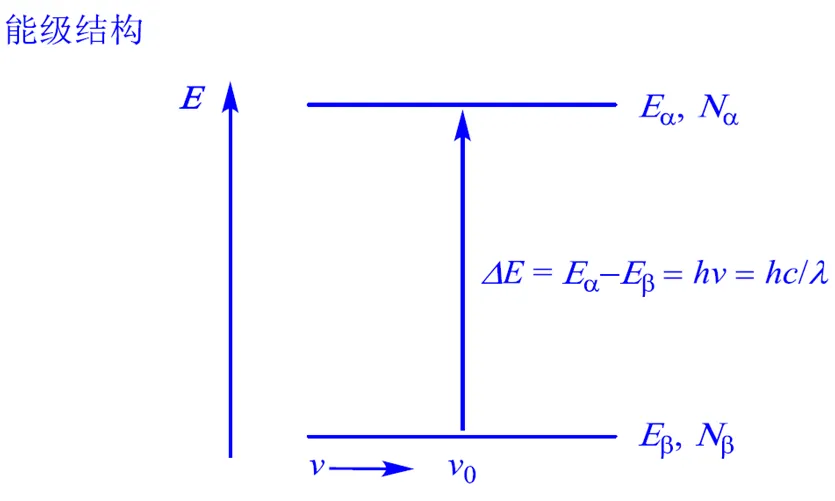
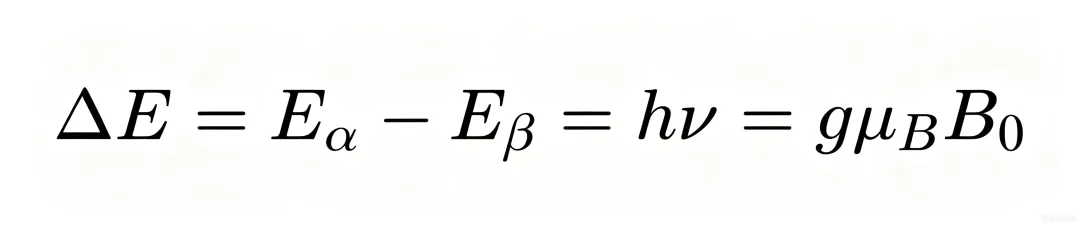
The EPR signal comes from a simple fact. Unpaired electrons occupy two spin energy levels, and the difference in population between those levels is what we detect. In an external magnetic field B0, electron spins undergo Zeeman splitting, creating two levels with ms = +1/2 and ms = -1/2. The energy gap between them is:
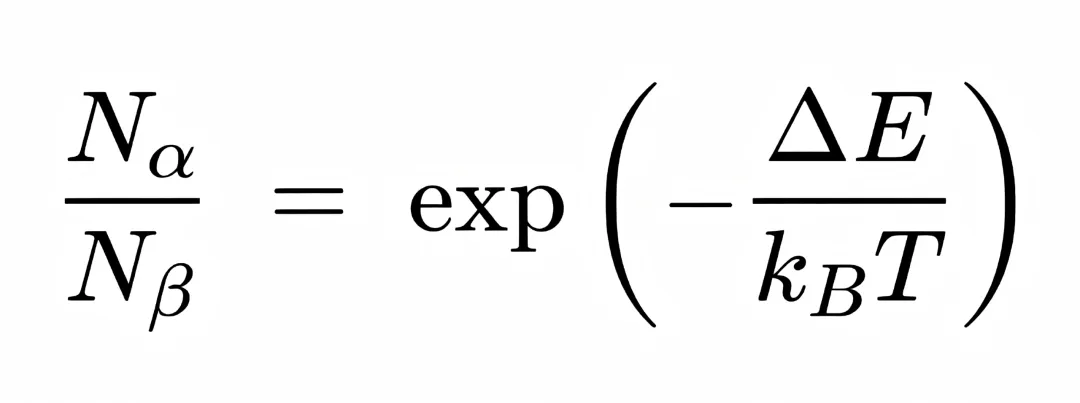
The Boltzmann distribution governs how electrons populate these levels. The population ratio depends on temperature in a very direct way:
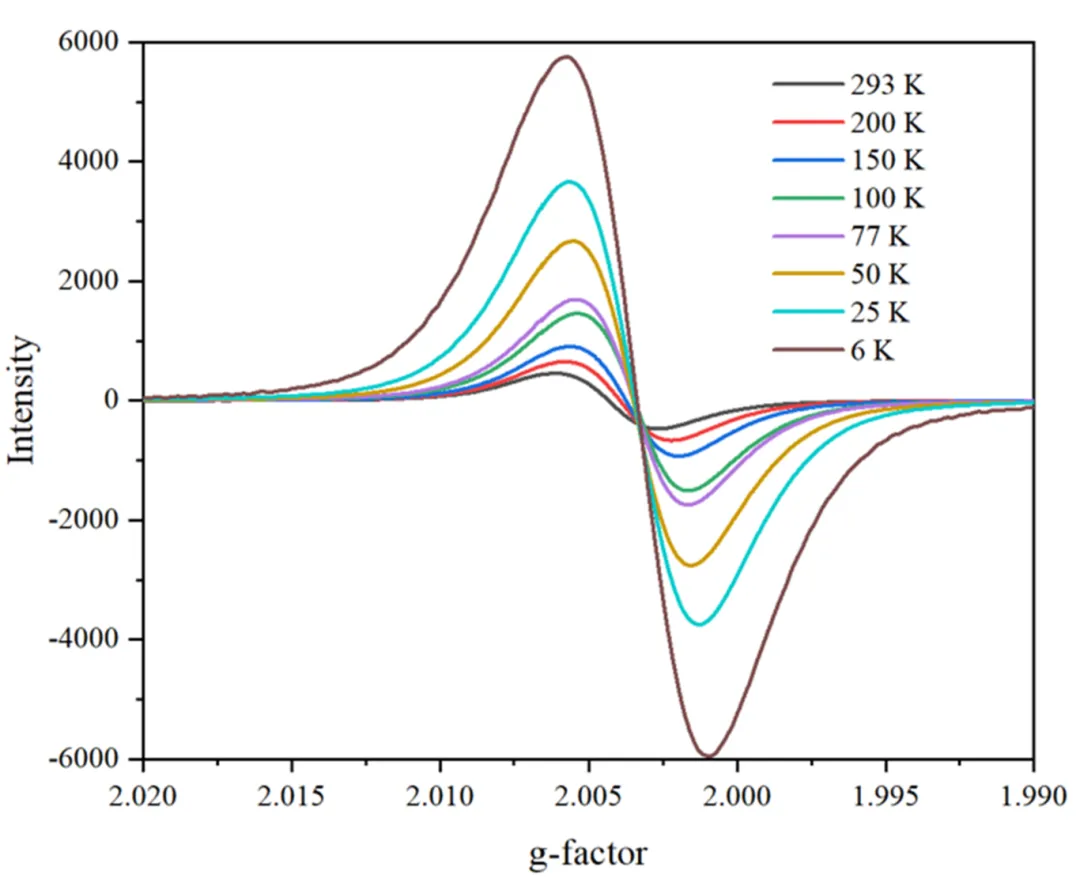
Here is what this means in practice. The EPR signal intensity is proportional to the population difference between the two levels. That difference scales as 1/T. In other words, lower the temperature, and your signal gets stronger. Period. Temperature is an independent, fully controllable variable, so cooling your sample is the most fundamental and direct way to boost absolute sensitivity in EPR spectroscopy.
EPR spectra of a weak coal sample measured at different temperatures. Lower temperatures deliver dramatically stronger signals. (Measured on CIQTEK EPR system.)
Temperature does not just affect signal strength. It also controls spin relaxation, which determines whether you can detect a signal at all. Relaxation in magnetic resonance falls into two categories.
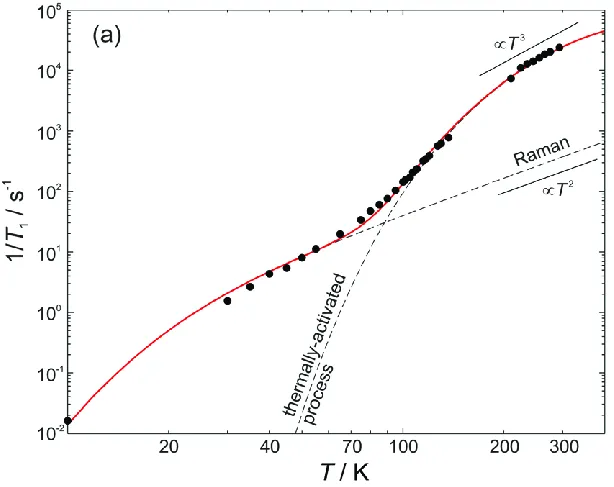
Spin-lattice relaxation (T1). This is the process where excited spins exchange energy with the surrounding crystal lattice. It is highly temperature-sensitive. At room temperature, lattice vibrations are vigorous. Excited spins dissipate their energy quickly, so T1 is short. Cool the system down, and you effectively "freeze" those lattice vibrations. T1 lengthens dramatically.
Spin-spin relaxation (T2). This arises mainly from magnetic dipolar interactions between neighboring spins. It is less directly affected by temperature.
Spin-lattice relaxation rate as a function of temperature. The strong temperature dependence shows why cooling is essential for short-relaxation systems. (Ref: Phys. Chem. Chem. Phys., 2020, 22, 15751-15758)
T2 controls the spectral linewidth. The homogeneous linewidth is inversely proportional to T2 (shorter T2, broader line). While T2 itself is not strongly temperature-dependent, T1 sets the theoretical upper limit for T2. If T1 is extremely short at room temperature, it forces T2 to be short too. By the Heisenberg uncertainty principle, this causes severe lifetime broadening. The line becomes so broad that it vanishes into the baseline noise. You see "no signal" when in reality, the signal is just hopelessly broadened.
This explains a common frustration in EPR labs.
·Room-temperature friendly: Organic radicals and ns1 configuration ions, which have longer T1 values.
·Room-temperature challenging: Most transition metal ions (such as Co(II), high-spin Fe(III)) and rare-earth ions. These are classic short-relaxation systems. At room temperature, they often give no usable signal at all. You need liquid-nitrogen or liquid-helium temperatures to see them.
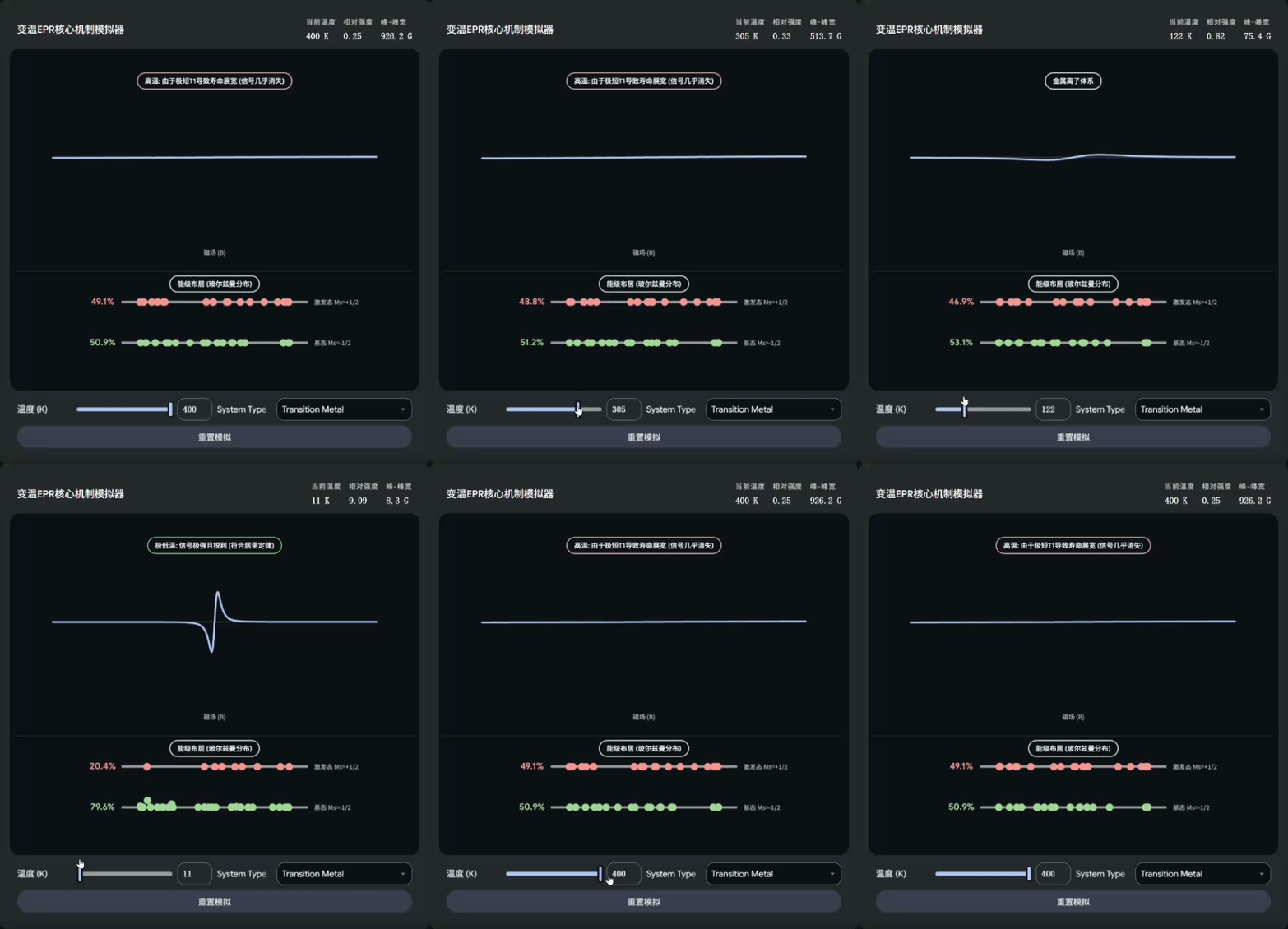
Variable-temperature EPR simulation showing how a signal becomes detectable as temperature decreases. Note that the EPR signal phase is inverted in this diagram.
Temperature Changes Molecular Motion, Reshaping Your Peaks
Stable organic radicals in solution and certain transition-metal complexes with long relaxation times already give clean signals at room temperature. So does temperature still matter for these systems? Absolutely.
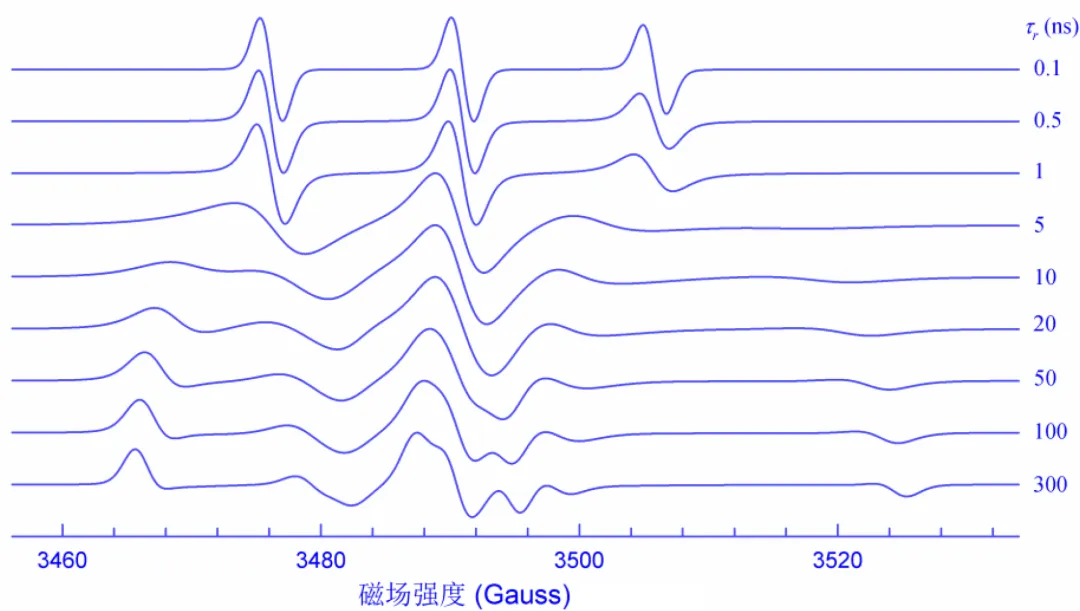
In room-temperature solution, molecules tumble rapidly and randomly, like tiny spinning tops. This tumbling averages out the anisotropy of the g-tensor and the hyperfine coupling tensor completely. The result is a symmetric, isotropic narrow peak.
As temperature drops, molecular motion slows down. Eventually the solution freezes into a glass, and molecular tumbling stops entirely. The anisotropy is no longer averaged away. Different spatial orientations reveal their full magnetic interactions. The simple isotropic peak transforms into a rich "frozen solution" spectrum packed with three-dimensional structural information. You can now extract details about the coordination environment and molecular orientation of the paramagnetic center.
Simulated EPR spectra of the R1NO• radical showing the evolution of correlation time τr. From top to bottom, τr increases as molecular motion slows from room-temperature dilute solution toward the frozen state. Simulation parameters: 9.8 GHz, gx=2.008, gy=2.006, gz=2.003, Ax=Ay=20, Az=85 MHz. (Adapted from Electron Paramagnetic Resonance: Principles and Applications.)
Which Temperature Setup Does Your Sample Need? A System Selection Guide
Different spin systems have very different energy-level structures and dynamic properties. That means they need very different temperature ranges for optimal EPR measurement.
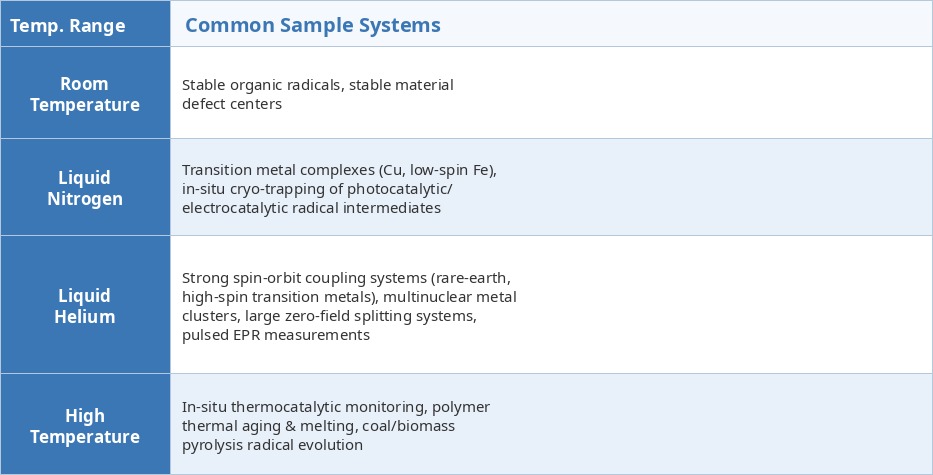
Optimal temperature ranges for common EPR sample categories. Match your system to the right temperature window for best results.
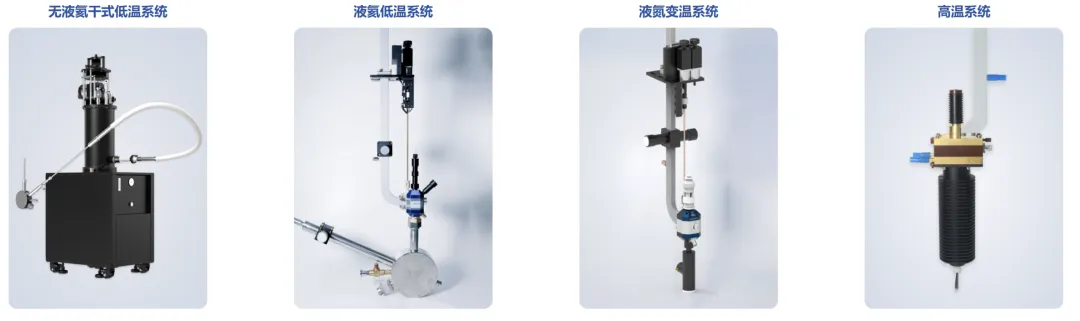
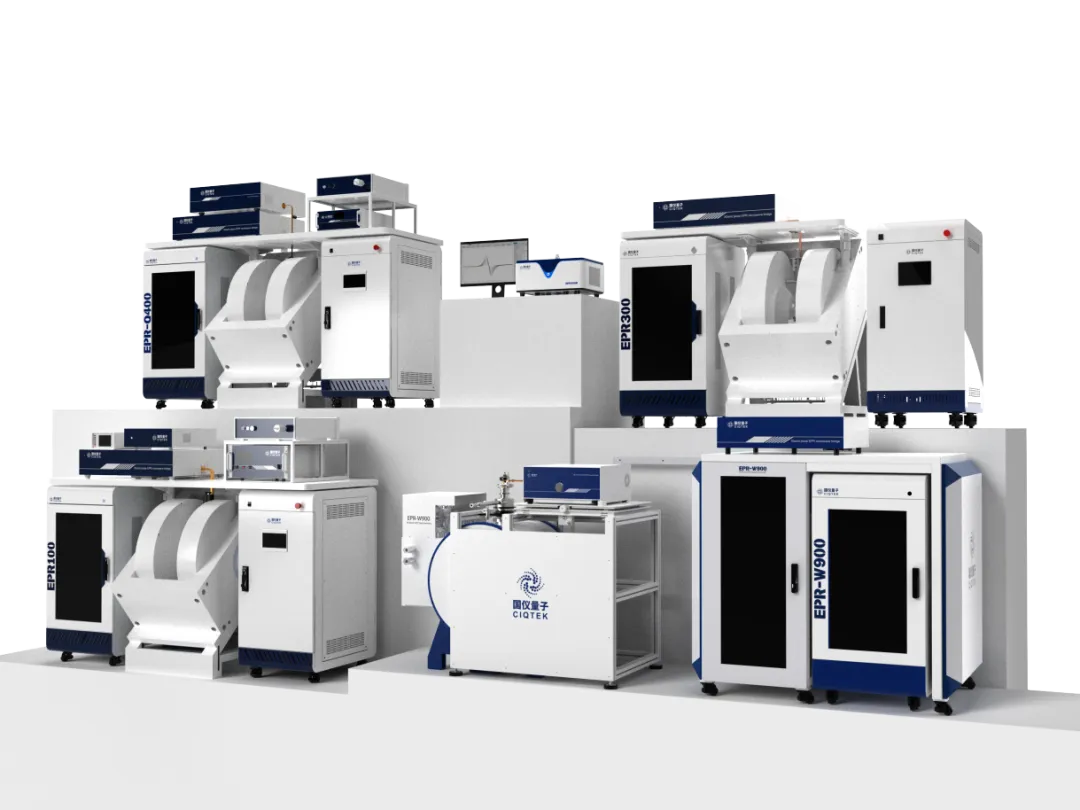
CIQTEK offers full-range variable-temperature EPR solutions compatible with all continuous-wave and pulsed EPR spectrometers. From routine characterization to frontier research, we have you covered.
Cryogen-Free Dry Cryostat System
Liquid helium is expensive and supply can be unreliable. Our closed-cycle refrigeration technology achieves zero helium consumption, eliminating helium dependency entirely. Operating costs are low, and the system is now the mainstream standard for advanced laboratories worldwide. If you run frequent low-temperature EPR measurements, this is the way to go.
Liquid Nitrogen Variable-Temperature System
One system covers the full range from liquid-nitrogen low temperatures up to medium-high temperatures. A single piece of equipment handles the vast majority of variable-temperature testing needs. This is the most popular, cost-effective all-around solution in laboratories today. If you need flexibility without breaking the budget, start here.
High-Temperature System
Purpose-built for in-situ high-temperature reaction studies. This is an indispensable tool for thermocatalysis and energy materials research. If your work involves catalytic processes or materials behavior at elevated temperatures, this system gives you the data you need.
Temperature Is the Key to the Spin World
Temperature is not just a number on a dial. It is the key that unlocks the microscopic spin world. Understand how your sample's properties connect to temperature, and you will dramatically expand what your research can achieve.
Cooler temperatures boost sensitivity through the Boltzmann factor. They lengthen relaxation times to reveal signals that would otherwise vanish into broadened noise. They slow molecular motion to expose anisotropic structural details hidden in room-temperature spectra. Each of these effects opens new experimental possibilities.
Whether you are studying organic radicals, transition-metal complexes, or rare-earth systems, the right variable-temperature setup makes the difference between a failed experiment and a breakthrough result.
Not Sure Which Variable-Temperature Setup Is Right for You?
Our application scientists are happy to evaluate your samples and recommend the optimal testing protocol. Get in touch, and let us help you get the most out of your EPR research.
Пожалуйста, не стесняйтесь обращаться к нам для получения более подробной информации, запроса ценового предложения или заказа онлайн-демонстрации! Мы ответим вам, как только сможем.